Living With Adenomyosis: The Fear, the Dizziness, and the Fight to Be Heard
My real experience with adenomyosis: fear, dizziness, brain fog, heavy bleeding, and the virtual doctor who finally connected the dots.
4/12/20266 min read
My post content
Adenomyosis: The Pain No One Prepared Me For
For almost ten years, I lived inside a body that felt like it was working against me. Every month arrived like a storm — heavy, unpredictable, and impossible to plan around. I kept telling myself it was normal. That other women handled it. That I just needed to push through.
But deep down, I knew something was wrong.
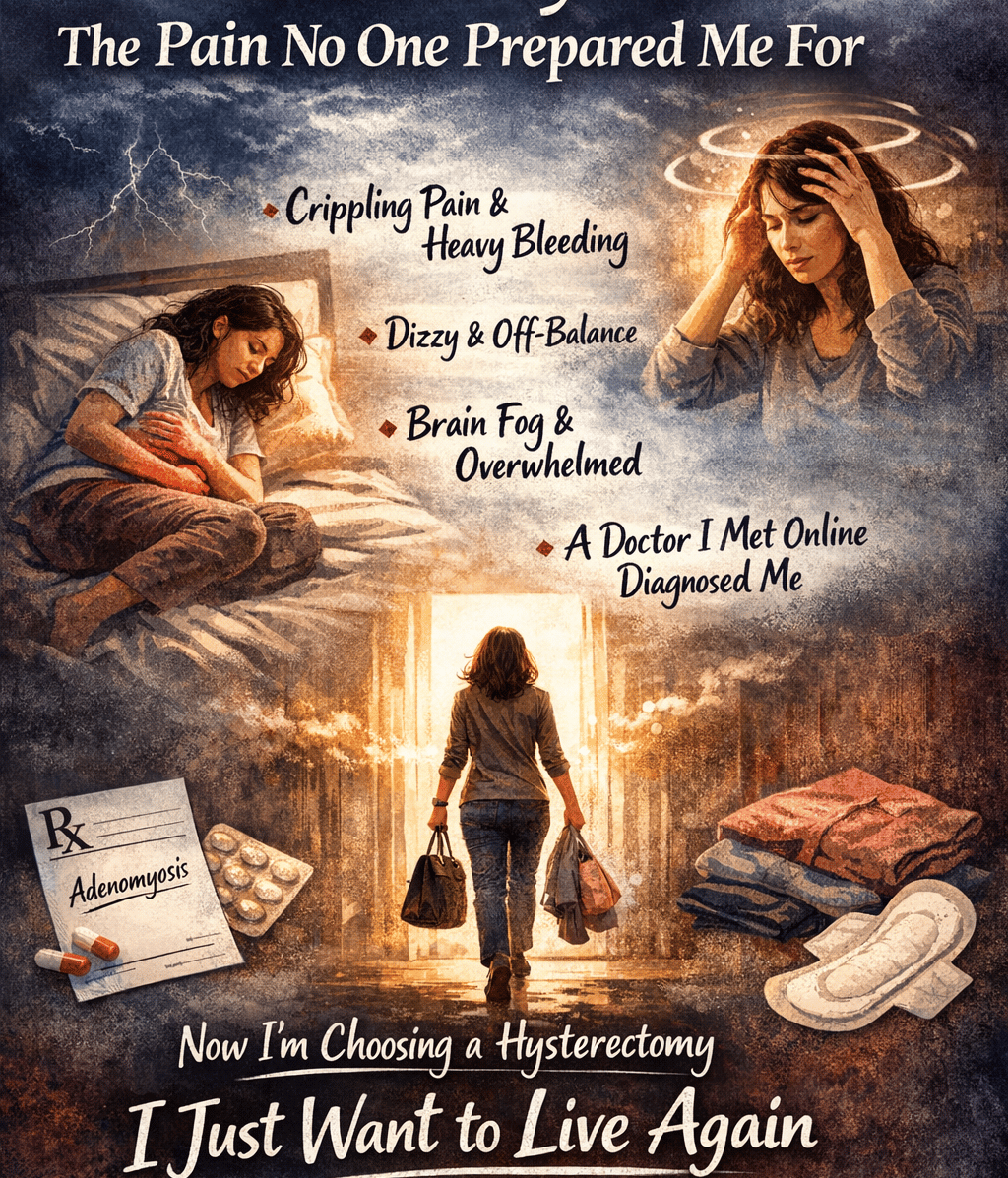
There were mornings I couldn’t stand up straight. Nights where I curled forward, breathing through cramps that felt like they were trying to split me open. I bled through clothes in under an hour. I cancelled plans. I rearranged my life around pain I didn’t have a name for.
Three surgeries in four years. Polyps removed. Fibroids removed. A uterus described as boggy on paper — and still, my gynecologist told me my pain “wasn’t my uterus.”
I lived like that for years.
What Is Adenomyosis? (In Real Words)
Adenomyosis happens when the endometrial tissue — the lining that’s supposed to shed during your period — grows into the uterine muscle instead of staying where it belongs.
This can make the uterus:
heavier
thicker
more inflamed
more sensitive
more painful
It’s often misdiagnosed as “bad periods,” “fibroids,” or “just stress.” If you want a deeper breakdown, explore adenomyosis basics.
Common Symptoms of Adenomyosis
Women often experience:
Heavy menstrual bleeding — soaking through pads/tampons in under 1–2 hours
Severe cramping — sharp, stabbing, or contraction‑like pain
Chronic pelvic pain — aching or pressure even outside your period
Painful sex — deep pelvic pain during penetration
Bloating or “adenomyosis belly” — lower belly fullness or swelling
Fatigue or anemia — exhaustion from blood loss
Fertility challenges — difficulty conceiving or maintaining pregnancy
Not everyone has all of these — but most women have enough that their life is disrupted.
My Real Turning Point
My turning point didn’t come from the doctor who knew my history. It didn’t come from the gynecologist who dismissed my pain, even with a printout describing my uterus as boggy — a classic sign of adenomyosis.
My turning point came from a virtual doctor I had never met.
I wrote out every symptom. Every surgery. Every fear. Every detail no one had ever taken seriously.
And in one appointment — one conversation with someone who didn’t know me at all — she said:
“This sounds like adenomyosis.” And then: “You need this surgery to get your life back.”
A stranger saw what my own doctor refused to see.
That moment changed everything. Not because I finally had a diagnosis — but because someone finally connected the dots I’d been carrying alone for years.
When Perimenopause Hits, Everything Intensifies
No one warned me that perimenopause would pour gasoline on a fire that was already burning.
The symptoms I’d been managing for years — the pain, the bleeding, the bloating, the exhaustion — suddenly had company. Mood swings. Anxiety. Heart palpitations. Nights where I couldn’t sleep and days where I felt like I was vibrating from the inside out.
Perimenopause doesn’t replace adenomyosis. It layers itself on top of it.
And that combination can make you feel overwhelmed, unstable, misunderstood, and out of control.
The Brain Fog No One Warns You About
One of the hardest parts of living with adenomyosis — especially when perimenopause hits — is the brain fog. Not the cute “oops I forgot my keys” kind. The kind that makes you feel like your mind is slipping away from you.
The kind that makes you lose words. Forget conversations. Stare at your phone and not remember what you were doing. Feel disconnected from yourself. Feel scared.
You’re not imagining it. You’re not failing. You’re not losing your mind. You’re navigating something incredibly hard — and you’re doing it with more strength than you realize.
The Dizziness That No One Talks About
Another symptom that hit me harder than I ever expected is the dizziness. Not a quick lightheaded moment — but a deep, unsettling off‑balance feeling that makes the whole world tilt.
It feels like:
the floor is uneven
your body is swaying even when you’re still
you need to hold onto walls or counters
your head is full of static
you can’t trust your own footing
There have been days where the dizziness alone kept me in bed. Days where standing felt like stepping onto a moving boat. Days where I was afraid to shower because I didn’t trust my balance. Days where I didn’t want to be alone because I didn’t know what my body might do next.
If you’ve felt this — that off‑balance, disorienting dizziness — you’re not alone. You’re not imagining it. You’re not weak.
This is what happens when your body is fighting on multiple fronts.
The Fear No One Talks About
There are days when the pain is one thing… and then there are the days when the bleeding is so heavy you’re scared to move.
The days when you’re stuck in bed, staring at the ceiling, feeling that hollow emptiness in your chest — the kind that comes from being terrified and alone at the same time. When you’re afraid to stand up. Afraid to take a shower. Afraid of what might happen if you’re not watching your body every second.
And yet somehow, even in that fear, you still have to be strong around people. You still have to smile. You still have to function. You still have to pretend you’re okay when your body is screaming that you’re not.
You’re not weak for feeling scared. You’re not dramatic for feeling overwhelmed. You’re not alone in this.
I Want to Live Again
There comes a point where the pain isn’t just physical anymore — it’s the way it steals your life. The way it traps you inside your house. The way you can’t leave without herbs, pads, extra clothes, and a backup plan for your backup plan.
I reached a point where I didn’t want to live like that anymore.
I want to leave my house without fear. I want to walk out the door without packing half my bathroom. I want to stop calculating how far I am from a washroom. I want to stop pretending I’m okay when my body is falling apart. I want to live again — not survive, not manage, not endure. Live.
My Next Step: A Hysterectomy
After years of pain, years of bleeding that left me scared to stand up, years of brain fog, dizziness, fear, and being dismissed, I’m having a hysterectomy in May.
This isn’t a decision I made lightly. It’s not something I ever imagined for myself. But when you’ve lived in a body that has hurt you for this long, you reach a point where you choose yourself.
Not because you’re giving up — but because you’re finally done suffering.
This is my next chapter. My chance to breathe again. My chance to live without fear of bleeding through everything I own. My chance to stop rearranging my life around pain.
And if you’re reading this and you’re on this path too — or you’re scared, or confused, or wondering if you’re the only one — you’re not alone. You’re not broken. You’re not weak. You’re a woman who deserves relief, answers, and a life that doesn’t revolve around pain.
Keep Learning. Keep Asking. Don’t Let Anyone Tell You It’s “Normal.”
One of the hardest lessons I’ve learned is this: You have to keep doing your own research. You have to keep asking questions. You have to keep paying attention to your body — even when you’re exhausted, scared, or overwhelmed.
Because too many women are told their pain is “normal.” Too many are told heavy bleeding is “just part of being a woman.” Too many are told to “wait it out,” “take a pill,” or “come back if it gets worse.”
But when you’re bleeding so heavily you’re afraid to stand up… When you’re stuck in bed feeling empty, alone, and terrified… When the dizziness makes you feel unsafe in your own body… When the brain fog makes you feel like you’re disappearing inside yourself…
That is not normal.
Your body is not lying to you. Your pain is not imaginary. Your fear is not an overreaction. Your experience is real — and you deserve to be taken seriously.
If You’re Reading This and Feeling Alone, You’re Not
If you’re sitting there wondering why your body feels out of control… If you’re questioning your sanity because perimenopause has layered chaos on top of pain… If you’ve been dismissed, minimized, or told “it’s normal” more times than you can count…
You’re not imagining it. You’re not dramatic. You’re not weak. You’re not alone.
You deserve answers. You deserve support. You deserve to be taken seriously.
Expert Voices & Sources
I always encourage women to learn from both lived experience and medical experts. Here are reputable places to explore:
Mayo Clinic
Cleveland Clinic
Johns Hopkins Medicine
NIH Women’s Health
If you want help choosing videos to embed, explore adenomyosis doctor videos.
Final Thoughts
Adenomyosis is real. It’s painful. It’s misunderstood. And too many women are living with it without answers.
If my story helps even one woman feel seen, understood, or validated — then sharing it is worth it.ext
Connect
Reach out for mindful wellness guidance
tania@wellnessmyway.online
© 2026. All rights reserved.